

Solar Kitchen
At the heart of the Solar Test Field is the kitchen, which feeds 50 people using solar technologies, including a Scheffler Mirror, biogas system, solar box-cookers, solar water heaters and a solar tunnel dryer for food preservation. Using the technologies in daily life is an essential part of our research. It helps us adapt them to our needs and use the feedback in our ongoing development.
“In our solar kitchen, we’re experiencing the reality of energy abundance, as we’ve decided to accept this gift we’re constantly receiving.”
JANOS VALDER, Former Technologist in the Test Field
Vision
The kitchen is where we’re bringing cycles together, so that people are integrated in a healthy food, water and energy cycle. Food comes from the gardens, we cook with sun and biogas, and we use water from the wells. There is no “food waste” as we use the biogas digester for cooking, and the remaining material becomes fertilizer for the land. What we eat goes into the compost toilets, again to be used on the land. Our human element is helping to drive a cycle of abundance.
Our kitchen is the heart and soul of the community living in the Solar Test Field. As well as serving nourishing vegan meals with locally grown food, the Village Plaza is a place for the community to gather.
A key principle of our research is how humans can co-exist in community. And this applies to the way we consume energy. People living in the Solar Test Field are learning how to use these new renewable technologies in a more considerate way. It’s an ongoing symbiotic relationship where we’re learning from our use and adapting to the development of the solar technologies.

Contribute to the Solar Test Field!
Your donation will allow us to maintain the Test Field and move towards a regenerative future.
Watch the Solar Test Field Kitchen in Action (2017)
Solar Technologies We Use
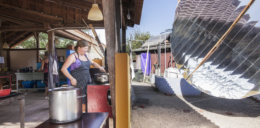
- The Scheffler Mirror is used to cook. It’s a solar reflector, where the shape and tracking system of the mirror are designed to concentrate sunlight onto a static collector outside the mirror’s aperture. The output of a reflector with a surface of 10m2 fluctuates depending on the season of the year from 2.2kW during the summer to 3.3kW during the winter, assuming solar radiation of 700W/m2. This mirror system enables solar cooking at high temperatures. Recently we started to use this mirror not only to collect the sun for cooking our food, but also to play with focusing moonlight to put into some of the seeds we sow in the garden. Read more…
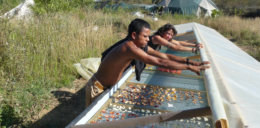
- The Solar Tunnel Dryer can be used to process seasonal surplus. One half of the floor of the tunnel dryer should be painted black to collect the heat of the sun. A solar-powered fan blows the hot air that rises off the black membrane, and dehydrates the food.
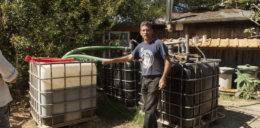
- Biogas digester – inspired by the designs of T.H. Culhane. Using biogas enables us to cook when there’s no sun – on cloudy days and at night. The technology ferments kitchen waste mixed with warm water to produce methane for cooking.
- Download a 3m³ biogas digester (floating drum system) construction manual in English and Portuguese.
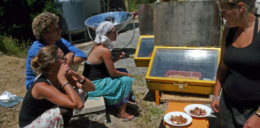
- Solar box-cookers – reflectors are used to direct sunlight to a small area to create heat for cooking. While small, they’re great for family use. For example, you can fill a pot with rice and vegetables in the morning and it’s cooked by lunch, and you can bake a cake at 150°C.
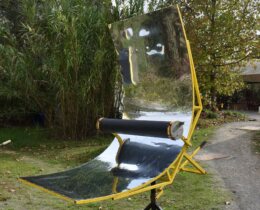
- Parabolic trough cookers – Those that we use are designed by Ivan Yaholnitsky, built, modified and documented in Tamera. Used daily to cook vegetables, capable of baking bread.

- Solar water heaters – flat plate collectors and evacuated tube collectors have proven their worth over the years.