

History of the Solar Test Field
Beginning in 2004, we worked for almost two decades with the physicist and inventor Jürgen Kleinwächter, researching and testing his ecological high-tech innovations in concentrating solar power technologies. Developing modular systems to deliver energy independence for a village community in the key areas of:
- electricity
- mechanics
- cooking
- heating
- cooling
- transport.
At the same time, optimizing plant growth conditions to produce high quality organic food in a small space, and using innovative ways to store thermal energy in gravel and oil.
“An essential contribution to our new models for settlements, where humans and nature cooperate, is our research into decentralized energy systems using solar technologies that can be built locally. By decentralized, we mean creating regional, relatively self-sufficient subsistence economies that are linked to each other. Worldwide exchange between autonomous regions will give rise to a humane and peaceful globalization.”
Barbara Kovats, elder
Solar Village in Action: The Test Field at Tamera Peace Research Center (2015)
Areas of Research
Ultralight Membrane Mirror (2015)
Tamera Ultralight Membrane Mirror – First Prototype (September 2016)
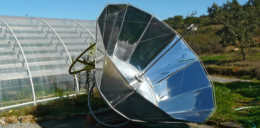
- The Ultralight Membrane Mirror: a high-performance, lightweight, low embodied energy optical system for concentrating solar energy – over 1,000 times to deliver heat over 1000°C. It consists of 6 individual mirror segments, each with an inflatable cushion of polymer film 0.1mm thick, floating over a lightweight rigid framework. The precision optical surface needed for high concentration is achieved by air pressure. The focused sunlight is directed to a fixed spot, close to the ground. When the mirror moves, the focused energy can be collected by a static installation.
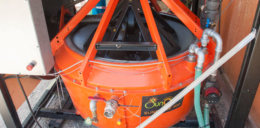
- The low temperature Stirling Engine: intended to be a main source of electrical and mechanical power. The engine is constantly heated in one part and cooled in another. The air in between expands when heated and contracts when cooled and this change of pressure drives a piston.
- The SunPulse Water: a solar water pump with a low-temperature Stirling Engine, running on sunlight, using air as its working fluid. It uses zero fossil fuel and creates zero emissions, and is a “stand-alone” system. With an output hydraulic power of 300W it’s ideal for decentralized water supply without any additional infrastructure.
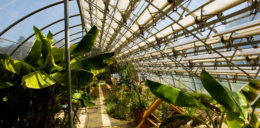
- The Envelope Power Greenhouse (EPG) is a greenhouse covered with UV-transparent ETFE (plastic sheeting) where we cultivate organic seedlings. The heat from the greenhouse was also used as an energy source to drive the SunPulse. As a proof of principle, we used a Fresnel lens system – the roof holds Fresnel concentrators which heat up a series of pipes containing vegetable oil. This circulated in a closed system and was stored in a tank, which retained the heat day and night, and the heated oil powered a kitchen for around 50 people. The hot oil flowed through double-walled cooking pots, so that the heat could be directly used for cooking. The hot oil also drove a low-temperature Stirling motor, the SunPulse Electric, which can produce 1.5 kW. The prototype is no longer in daily use, but we’ve used it when developing our current generation of energy collectors and Stirling engines to be installed in the Test Field as part of our energy autonomy project.